Understanding your child's CAT4 report — a calm parent's guide
September 20, 2026

The report arrives, and it looks like it was written for someone with a psychology degree. SAS. Stanine. NPR. Group rank. A little chart with dots. A number that's either reassuringly or alarmingly far from 100.
Take a breath. By the end of this guide you'll be able to read every part of it — and, just as importantly, you'll know which parts not to over-read.
(New to the CAT4? Start with what the CAT4 really is and the four parts it's built from, then come back here.)
First, the one rule that keeps you sane
Every number on the report is just a different way of answering one question: "How did this child do compared with other children the same age?" Not compared with the class. Not compared with a fixed "pass mark." Compared with a national sample of children the same age. That's what makes it fair — and it's why you shouldn't read any single number as a verdict.
SAS — the Standard Age Score (the main one)
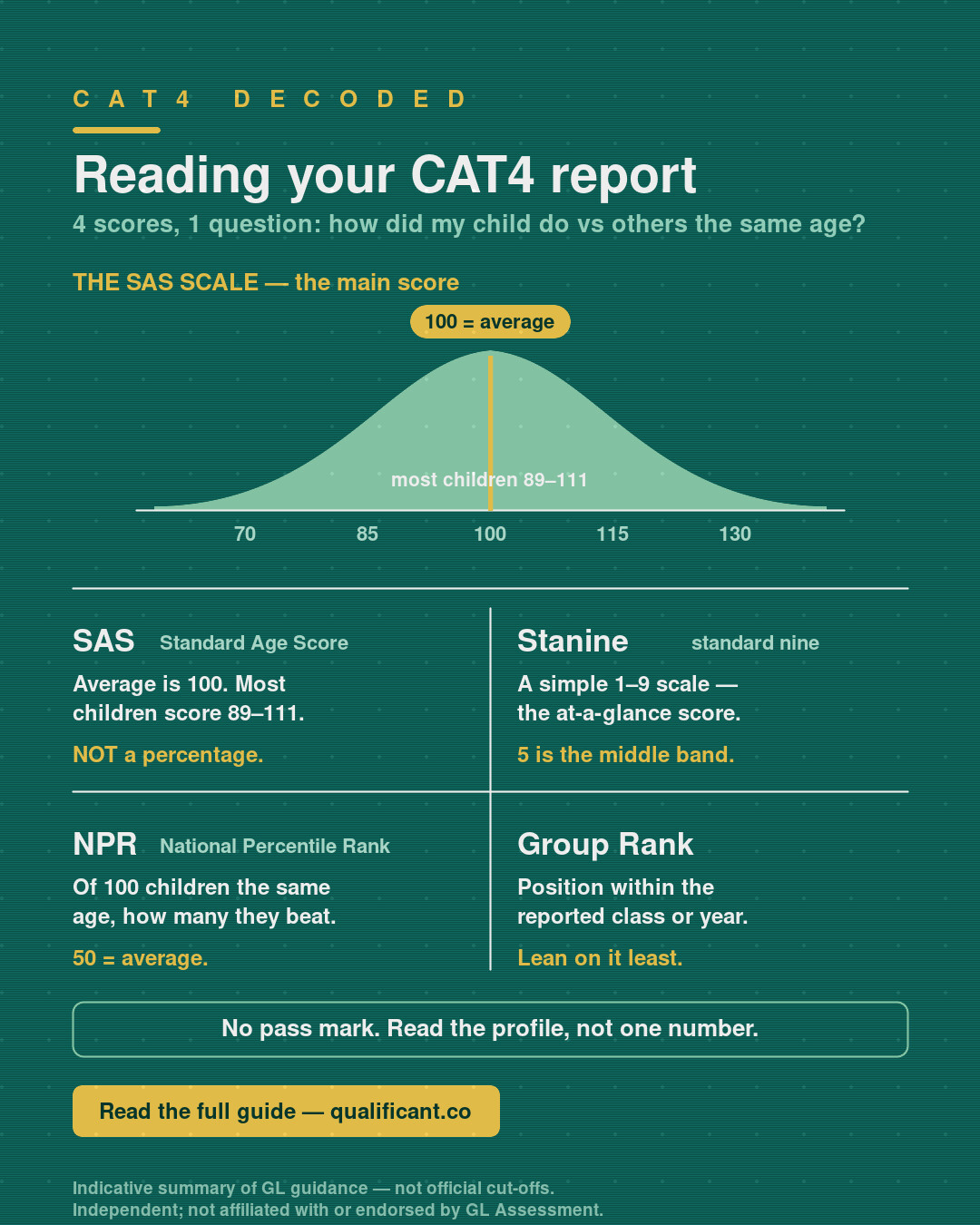
The SAS compares your child to other children of the same age, adjusted right down to their date of birth. The scale is built so that 100 is exactly average, most children — about two-thirds — score between 89 and 111, and scores spread from roughly 59 to 141. So a SAS of 100 doesn't mean "50% correct" — it means "bang in the middle for their age."
A rough map of the bands GL uses: 127+ well above average · 112–126 above average · 89–111 average (where most children sit) · 74–88 below average · below 74 well below average, likely needs support. Treat these as broad zones, not tripwires — a SAS of 111 and 113 are essentially the same child.
Stanine — the quick 1-to-9 version
A stanine squashes the whole scale into a simple 1 to 9, where 5 is the average band and 9 is the highest. It's the "at a glance" score. Rough translation: 1–3 below average, 4–6 the broad average zone, 7–9 above average.
NPR — the National Percentile Rank
The NPR answers: out of 100 children the same age, how many would my child score at or above? 50 is dead average. An NPR of 84 means they scored at or above 84 out of 100. Percentiles look dramatic because they run 1 to 99, but the gap between the 50th and 60th percentile is tiny in real terms.
Group Rank — where they sit in their own group
Group rank places your child within whichever group the school reported on — often their class or year ("12th of 30"). Useful context for the school, but the score to lean on least at home: it depends entirely on who else is in the group, not on any national standard.
Reading the shape, not just the scores
The report shows a SAS for each of the four batteries (Verbal, Non-Verbal, Quantitative, Spatial). The pattern across the four is more revealing than any single number. An even profile is a balanced all-rounder; a spiky profile (say strong Spatial and Non-Verbal, softer Verbal) is extremely common and usually a signpost, not a problem — often a strong thinker who simply needs more words in their world. Ask not "what's the number?" but "what's the shape, and what does it tell me about how my child likes to think?"
What's a "good" score? A better question
There's no pass mark, and "good" depends entirely on why the test was taken. A score that's perfect for setting classroom targets might be viewed differently for a selective entrance exam. The far more useful question is: "Given this profile, what's the one thing that would help my child most?"
The calm next step (what actually helps)
Whatever the report says, the productive response is the same: don't reduce it to one number or one feeling; read the profile and notice the shape. Pick the softest area and feed it gently (reading for Verbal, building and folding for Spatial, number-pattern games for Quantitative, puzzles for Non-Verbal). Think months, not nights — reasoning grows with steady, low-pressure practice, never with cramming. And keep it calm: your tone at the kitchen table matters more than any stanine.
Turn the report into a plan — without the pressure
A CAT4 report is at its best when it becomes a quiet map of where to help next. That's what Qualificant is built to do: for Nigerian Primary 5–6 learners, we turn each area of reasoning into calm, animated, one-idea-at-a-time practice. See how it works with a free taster at qualificant.co/try — and if you've got a report in front of you, start with the battery your child scored lowest on.
Qualificant is an independent exam-readiness platform and is not affiliated with or endorsed by GL Assessment. Score bands are indicative summaries of GL's published guidance, not official cut-offs — always read them alongside your school's own advice. We don't guarantee scores or admission.