Inside Nigeria's most competitive entrance exams — what the numbers really say
September 20, 2026
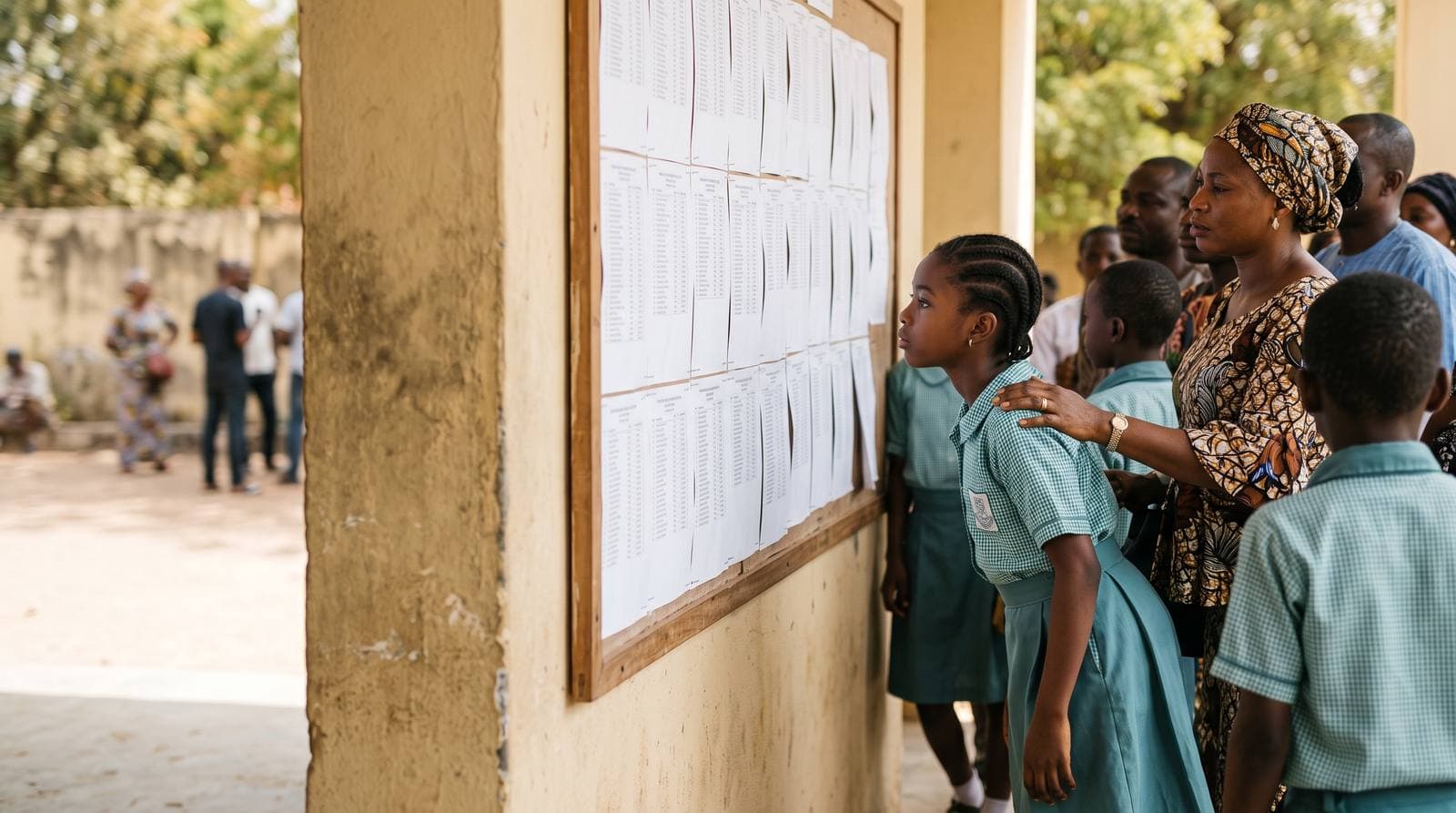
It usually arrives in a WhatsApp group around exam season. A screenshot. A table of states with wildly different cut-off marks beside them — 139 for one state, 2 for another. Someone adds a furious voice note. Someone else forwards it to three more groups.
If you've ever stared at that image at 11pm wondering what your child is actually up against, this one's for you.
Let's start with the most useful thing we can tell you about it: that chart is probably five years old.
First, the myth
When that image went viral again as "the 2025 cut-off marks", the fact-checking organisation Dubawa traced it back to Twitter in 2020 — and confirmed that neither NECO nor the Federal Ministry of Education had released any such list for 2025. NECO's Director of Information was blunt about it: "It is fake. The examination is yet to be conducted." (Dubawa)
The figures in it — Anambra at 139, Imo at 138, Yobe at 2 — are real numbers from an old year, recycled every season as if they were this year's news.
We mention this first because it sets the tone for everything below. There is a lot of noise around these exams. There are also real, published numbers. It's worth knowing which is which before you decide how worried to be.
The National Common Entrance: big, but not one single race
Here's what the 2026 exam actually looked like, announced by the Minister of State for Education, Professor Suwaiba Sa'id Ahmad:
- 60,357 children registered. 56,950 actually sat. 3,407 didn't turn up.
- The paper was marked out of 210. The highest score was 202 — achieved by exactly 10 children in the country.
- They were competing for places in 83 Federal Unity Colleges.
- The exam ran on Saturday 6 June 2026, in Nigeria, Benin Republic and Togo. (Voice of Nigeria)
Now here's the part most parents genuinely don't know, and it changes how you should read that viral chart.
Places at unity colleges are not awarded purely on who scored highest nationally. The Minister restated the criteria plainly: 60% merit, 30% equality of state, and 10% exigency.
Read that again, because it matters. Only 60 of every 100 places go on raw score alone. Thirty are distributed to balance representation across states. Ten are held back for special circumstances.
What that means for you, practically: your child is competing mostly against other children from your own state of origin, not against all 57,000. A brilliant score in a state where thousands apply is a different proposition from the same score in a state where a few hundred do. That is the actual mechanism behind those lopsided cut-off numbers — not a mistake, but a deliberate federal policy.
Whether that policy is fair is a live and genuinely contested debate in Nigeria, argued well on both sides in the national press. We're not going to settle it here. But you should understand it, because it's the single biggest factor in what "competitive" means for your family specifically.
Lagos Model Colleges: a completely different logic
Cross to the Lagos State Model Colleges and the rules change entirely.
For the 2026 screening, registration opened on 19 January and closed 15 May. The test itself was computer-based, held over three days in late May, covering English, Mathematics and General Knowledge, with a ₦10,000 registration fee. It's open to Primary 6 pupils in Lagos public and private schools; children claiming Lagos origin upload an indigeneship certificate. (Nairametrics)
And crucially: placement is strictly merit-based on the CBT performance, with cut-off marks varying by school. No state-balancing formula. The strongest scores get the most sought-after colleges.
Lagos doesn't publish an applicant-to-place ratio, so anyone quoting you one is guessing. What we can say honestly is that the selection logic is simpler and harsher than the federal one: it's your child's score against everyone else's, and the best-known colleges set the highest bars.
One practical detail deserves emphasis. It is a computer-based test. For a child who has only ever done exams on paper, the screen itself is a variable — navigating questions, watching a timer, flagging something to come back to. That's a skill, and it's separate from knowing the maths.
The private and international schools: a third set of rules
The third door is the least standardised, and the hardest to generalise about, because every school runs its own process.
Greensprings, for example, publishes a straightforward Year 7 entrance examination in English and Mathematics, with a ₦20,000 registration fee and both in-person and online sittings. (Greensprings School)
Others in the international tier add something different: a cognitive abilities test, most commonly the CAT4 from GL Assessment. This isn't a subject exam. It doesn't test what your child has memorised — it tests how they reason with words, numbers, shapes and patterns. Schools like it precisely because it's harder to coach, and because it tells them something a maths paper doesn't.
If you're aiming at that tier, it's worth knowing early, because it's the one assessment where "more past questions" is genuinely the wrong preparation strategy.
So what should a parent actually do?
Three things, in order.
Know which door you're aiming at. The three routes reward different things. Federal unity colleges are a score-plus-policy calculation weighted by your state. Lagos Model Colleges are pure score on a screen. Private and international schools are school-by-school, and some are assessing reasoning rather than recall. Preparing for all three identically is the most common wasted effort we see.
Check dates yourself, at source. Registration windows are the quiet killer — the 2026 Lagos window closed in May, months before the exam. Every year, capable children miss out on a portal deadline rather than on the paper. Put the official registration portal in your calendar, not a WhatsApp forward.
Make the format boring before the day. This is the part you actually control. Whatever the door, a child who has already sat a full-length, timed test on a screen walks in with one less unfamiliar thing to handle. The maths doesn't change. The nerves do.
Where to start
If your child is in Primary 5 or 6 and any of these doors are in your plan, the simplest first step is to let them see what a timed, on-screen test feels like — with nothing riding on it.
At Qualificant we build calm, timed practice for Nigerian Primary 5–6 learners, on the same kind of screen they'll meet on the day. You can try a few free questions, no signup, at qualificant.co/try.
Qualificant is an independent exam-readiness platform. We are not affiliated with or endorsed by NECO, the Federal Ministry of Education, Lagos State, GL Assessment, or any school. We don't guarantee scores or admission — we help children build genuine reasoning and walk in calm and familiar with the format. Exam dates, fees and criteria change: always confirm current details on the official portal for the exam you're sitting.